Making energy while the sun shines… a look at the solar sector
At Close Brothers Asset Finance we’re into renewable energy in a big way, funding wind farms, solar farms and also battery storage facilities
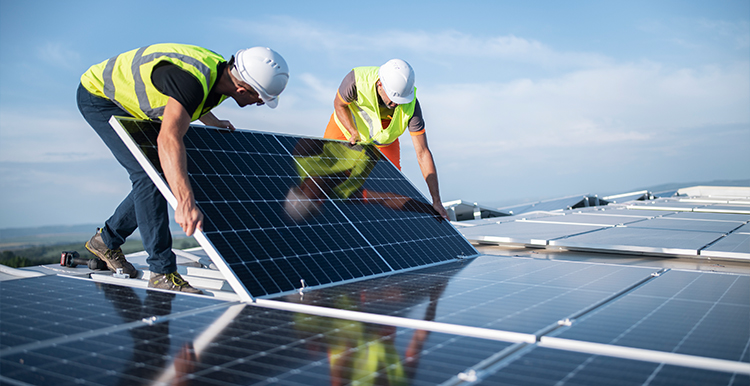
We’re understandably proud of our leading role in this sector, but in this piece we take a closer look at the solar sector across the UK.
Renewable energy consumption, as a whole, in the UK has taken off strongly since 2010, hitting 1.2 exajoules in 2020, which is the equivalent of around 200 million barrels of oil.
Looking at solar specifically in 2021, global cumulative solar PV capacity amounted to 940 gigawatts, with roughly 168 gigawatts of new PV capacity installed in that same year (one gigawatt can power around one million homes for an hour).
The growth in the solar PV use represents a very real shift towards renewable and distributed energy technologies. As of 2021, China and the United States led the global PV market, with 307 and 122 gigawatts of cumulative solar PV capacity, respectively. Chile and Honduras have the highest share of PV electricity consumption.
What’s happening in the UK…
In the UK, the cumulative installed capacity of solar PV has increased significantly over the past decade, from 95 megawatts in 2010, to 13,965 megawatts by the end of 2021.
This has slowed over recent years as government grants have come to an end and the debate around building solar farms on arable land continues, despite public support for solar reaching 84%, higher than any other renewable technology (source: UK Department for Business, Energy and Industrial Strategy).
By the end of 2021, there were over 1.13m solar PV sites in the UK, with the boom in installations taking place between 2010 and 2015. With the market becoming more competitive, installation costs have fallen in recent years, with prices for small scale solar PV systems ranging between £1,165 and £2k per kilowatt.
In 2021, electricity production from solar PV was 12,138 gigawatt hours, up from just four gigawatt hours in 2004. Since 2016, the UK has generated over 10k gigawatt hours every year.
Despite the growth in installations, turnover in the sector has declined markedly since 2015, when it peaked at £2.7bn – in 2020 the figure stood at £1.4bn. At the same time, the number of people employed in the sector full-time fell from nearly 10k in 2015 to 5.5k in 2020.
Small scale solar PV installation costs
Costs have remained relatively stable for small scale solar PV installations, with the biggest increases seen in the 0-4KW band, followed by those in the 4-10KW band.
In terms of installations, the highest number occurred in March 2019 (7,818), which was primarily due to the closure of the Feed-in Tariff scheme, which was introduced in April 2010. It was a government program designed to promote the uptake of low-carbon and renewable electricity generation technologies. By October 2020, the total capacity of Solar PV installations under the FIT scheme reached roughly 5.1 gigawatts; the scheme ended in April 2019.
Energy use
Since 2018, annual consumption of solar energy in the UK increased to the point where it equated to saving 1.1m metric tons of oil.